Forecast OSEM model
forecast_model.RdForecast OSEM model
Usage
forecast_model(
  model,
  exog_predictions = NULL,
  n.ahead = 10,
  ci.levels = c(0.5, 0.66, 0.95),
  exog_fill_method = "AR",
  ar.fill.max = 4,
  plot = TRUE,
  uncertainty_sample = 100,
  quiet = FALSE
)
Arguments
- model
A model object of class 'osem'.
- exog_predictions
A data.frame or tibble with values for the exogenous values. The number of rows of this data must be equal to n.ahead.
- n.ahead
Periods to forecast ahead
- ci.levels
Numeric vector. Vector with confidence intervals to be calculated. Default: c(0.5,0.66,0.95)
- exog_fill_method
Character, either 'AR', 'auto', or 'last'. When no exogenous values have been provided, these must be inferred. When option 'exog_fill_method = "AR"' then an autoregressive model is used to further forecast the exogenous values. With 'last', simply the last available value is used. 'auto' is an
auto.arimamodel.- ar.fill.max
Integer. When no exogenous values have been provided, these must be inferred. If option 'exog_fill_method = "AR"' then an autoregressive model is used to further forecast the exogenous values. This options determines the number of AR terms that should be used. Default is 4.
- plot
Logical. Should the result be plotted? Default is TRUE.
- uncertainty_sample
Integer. Number of draws to be made for the error bars. Default is 100.
- quiet
Logical. Should messages about the forecast procedure be suppressed?
Value
A list of class 'osem.forecast' with the following elements:
- forecast
A tibble with the forecasted values for each module.
- orig_model
The original model object of class 'osem'.
- dictionary
The dictionary used for the model.
- exog_data
A tibble with the exogenous data used for the forecast.
- exog_data_nowcast
A tibble with the exogenous data used for the nowcasting.
- nowcast_data
A tibble with the nowcasted data.
- args
A list with the arguments used for the forecast.
- full_forecast_data
A tibble with the full forecast data, if available.
Examples
spec <- dplyr::tibble(
type = c(
"d",
"d",
"n"
),
dependent = c(
"StatDiscrep",
"TOTS",
"Import"
),
independent = c(
"TOTS - FinConsExpHH - FinConsExpGov - GCapitalForm - Export",
"GValueAdd + Import",
"FinConsExpHH + GCapitalForm"
)
)
# \donttest{
spec <- dplyr::tibble(
type = c(
"d",
"d",
"n"
),
dependent = c(
"StatDiscrep",
"TOTS",
"Import"
),
independent = c(
"TOTS - FinConsExpHH - FinConsExpGov - GCapitalForm - Export",
"GValueAdd + Import",
"FinConsExpHH + GCapitalForm"
)
)
a <- run_model(specification = spec,
input = sample_input,
primary_source = "local",
constrain.to.minimum.sample = FALSE)
#>
#> --- Estimation begins ---
#> Estimating Import = FinConsExpHH + GCapitalForm
#> Constructing TOTS = GValueAdd + Import
#> Constructing StatDiscrep = TOTS - FinConsExpHH - FinConsExpGov - GCapitalForm - Export
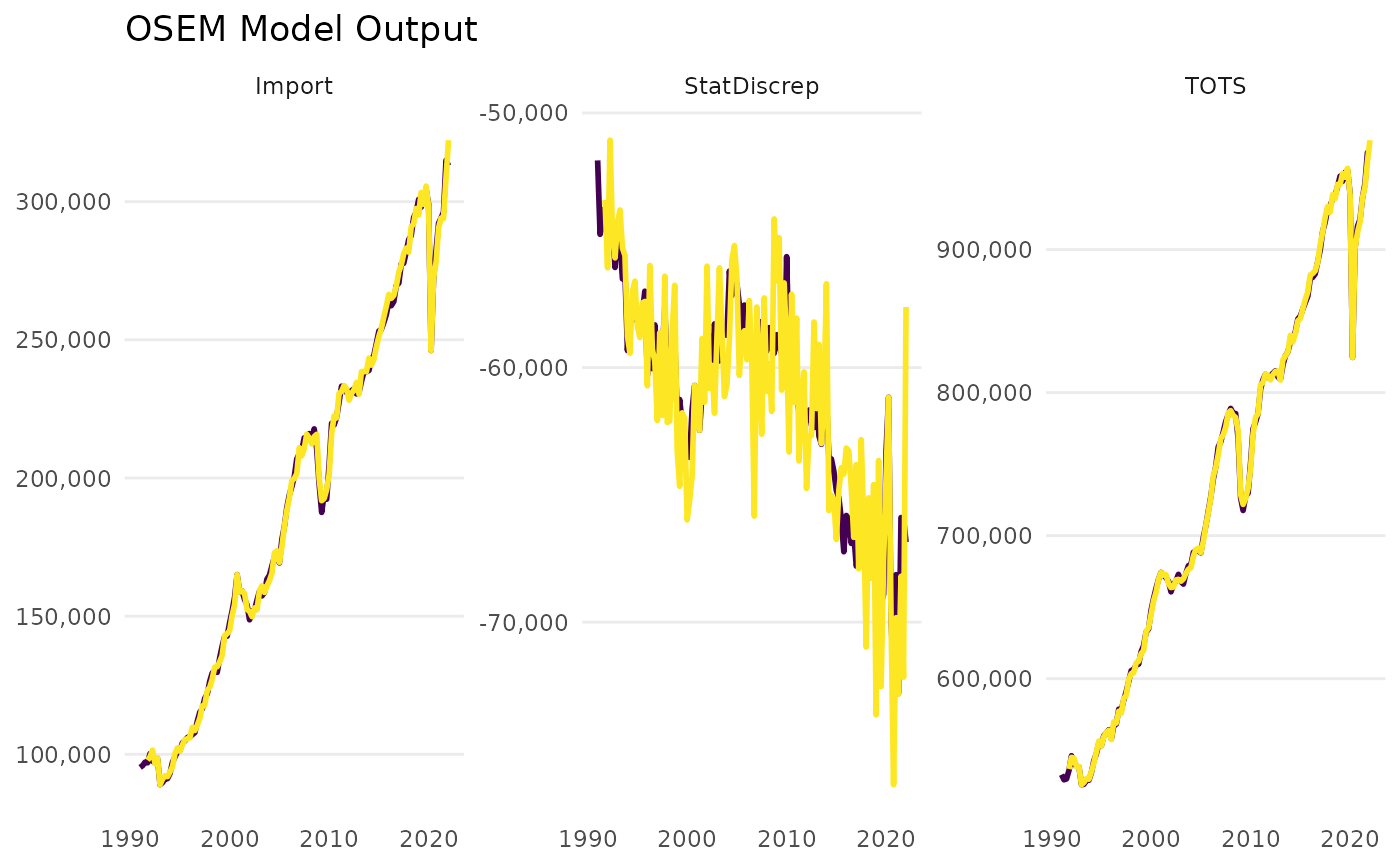 forecast_model(a)
#> No exogenous values provided. Model will forecast the exogenous values with an AR4 process (incl. Q dummies, IIS and SIS w 't.pval = 0.001').
#> Alternative is exog_fill_method = 'last'.
forecast_model(a)
#> No exogenous values provided. Model will forecast the exogenous values with an AR4 process (incl. Q dummies, IIS and SIS w 't.pval = 0.001').
#> Alternative is exog_fill_method = 'last'.
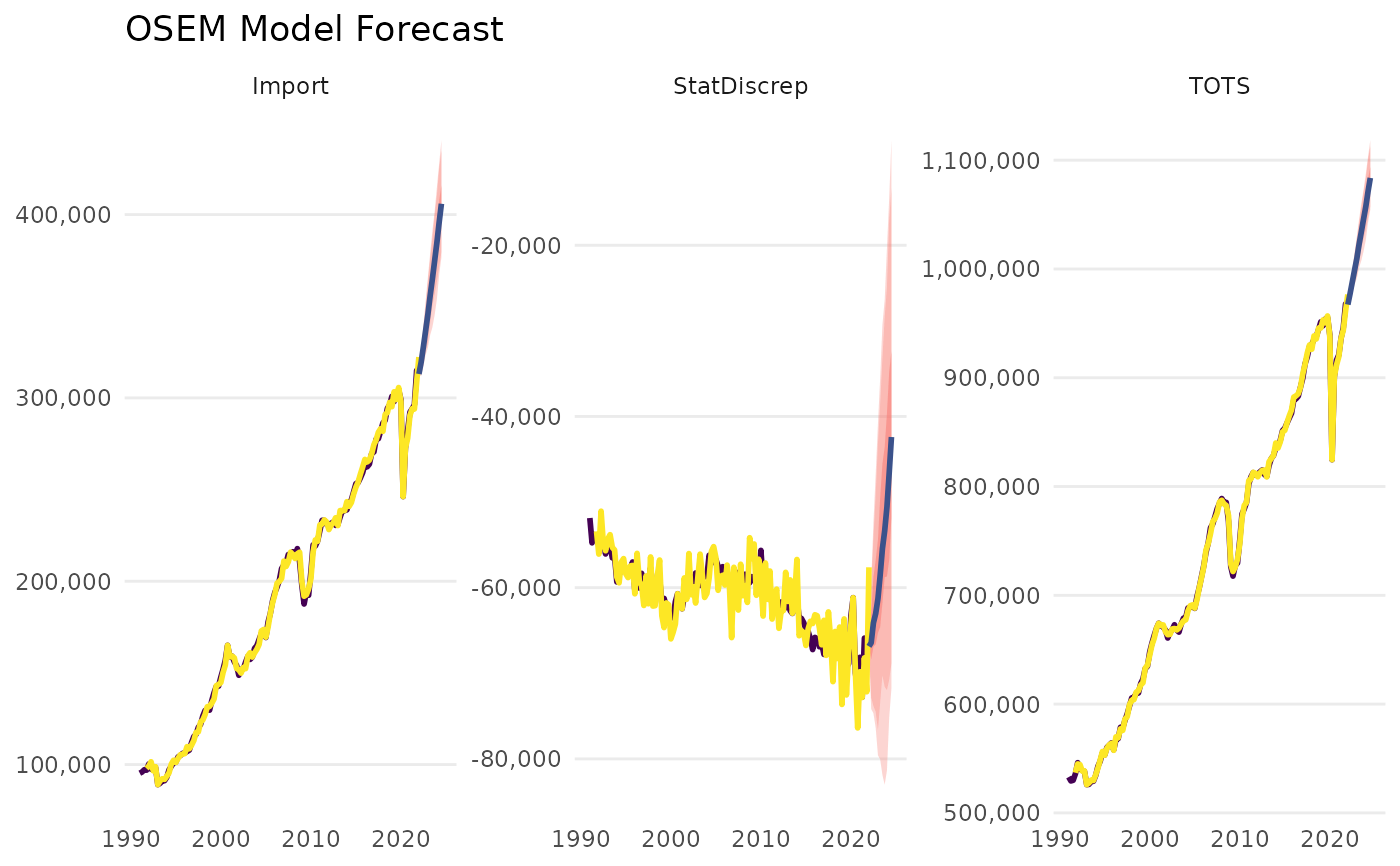 #> OSEM Model Forecast Output
#> -----------------------
#>
#> Forecast Overview:
#> Forecast Horizon: 2022-07-01 to 2024-10-01
#> Forecast Method: AR Model (Outlier and Step Shift Corrected)
#> Max AR Length: 4
#>
#> Central Forecast Estimates:
#> # A tibble: 10 × 4
#> Date Import TOTS StatDiscrep
#> 1 2022-07-01 46750. 118296. -8925.
#> 2 2022-10-01 47461. 120244. -8117.
#> 3 2023-01-01 47439. 121404. -7812.
#> 4 2023-04-01 47386. 122288. -7748.
#> 5 2023-07-01 47720. 124005. -7287.
#> 6 2023-10-01 47817. 125479. -6636.
#> 7 2024-01-01 48119. 127175. -6181.
#> 8 2024-04-01 48028. 128609. -5880.
#> 9 2024-07-01 48208. 130441. -5455.
#> 10 2024-10-01 48509. 132521. -4652.
#> OSEM Model Forecast Output
#> -----------------------
#>
#> Forecast Overview:
#> Forecast Horizon: 2022-07-01 to 2024-10-01
#> Forecast Method: AR Model (Outlier and Step Shift Corrected)
#> Max AR Length: 4
#>
#> Central Forecast Estimates:
#> # A tibble: 10 × 4
#> Date Import TOTS StatDiscrep
#> 1 2022-07-01 46750. 118296. -8925.
#> 2 2022-10-01 47461. 120244. -8117.
#> 3 2023-01-01 47439. 121404. -7812.
#> 4 2023-04-01 47386. 122288. -7748.
#> 5 2023-07-01 47720. 124005. -7287.
#> 6 2023-10-01 47817. 125479. -6636.
#> 7 2024-01-01 48119. 127175. -6181.
#> 8 2024-04-01 48028. 128609. -5880.
#> 9 2024-07-01 48208. 130441. -5455.
#> 10 2024-10-01 48509. 132521. -4652.
 # }
# }